H is for Hit By a Flying Wolf

Here’s a book recommendation brought to you by the letter H.

Hit by a Flying Wolf by Nicole Wilde
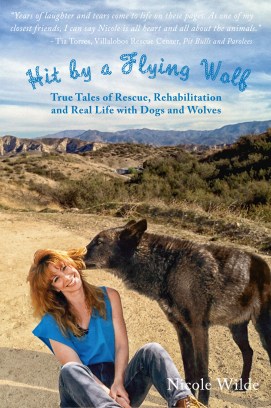
Cover-for-ebook

Yesterday, I quoted from Nicole Wilde’s blog post about growling. As a follow-up to that and my post on the Evolution of Dogs and Wolves, I decided H-day was a good opportunity to tell you about her latest book.

Since Wilde is a dog behavior expert, and I screwed up so many things with our first dog, I didn’t expect Hit by a Flying Wolf to so closely echo my own experiences. How reassuring to learn that an expert has struggled with a dog as much as I have!

The first half of the book contains stories about four of the dogs Wilde has lived with, and the second half concerns wolf rescue. The first dog, a long-haired German shepherd, had the same fear of high-pitched noises that Mia has. Mojo, Wilde’s “soul dog,” was the crossover dog who helped her learn that positive reinforcement training is more effective than using old-fashioned choke collars.

I have a special affinity for Bodhi, who came from a shelter and shared my dog Leo’s penchant for doing things like “grabbing a trailing hand and chomping down, or jumping up in front of me and placing teeth around my arm, exerting a disturbing amount of pressure.” Bodhi’s story hit home the most for me, because it illustrates how much dedication is needed sometimes to get through to a troubled dog, and shows that it’s worth it.

A major highlight of this book are the color photographs. I read a lot of books about dogs, and it bums me out when the photos are grainy and black and white, or worse, when there are no photos at all. I want to see the dogs! Wilde is an accomplished photographer. Not only are the animals described vividly in prose, but the images of the dogs and wolves also are stunning.

I learned about the risks of keeping wolfdogs as pets from Ceiridwen Terrill’s Part Wild. Terrill’s story was heartbreaking, but Hit by a Flying Wolf demonstrates how wolves and wolfdogs can be safely contained and cared for after living in a home hasn’t worked out for them. While not an endorsement of keeping wolves as pets, Wilde’s stories about the wolves are touching, suspenseful, and entertaining.

H is for Hit by a Flying Wolf

H

Powered by Linky Tools

Click here to enter your link and view this Linky Tools list…

Pit Bulls are Lovers, Not Fighters

During my morning hop through the blogosphere, I learned that today is National Dog Fighting Awareness Day, and feel compelled to contribute.

I’ve never known any fighting dogs, and until recently, I didn’t really know any pit bulls very well. I’ve been a fan of Pit Bulls and Parolees since it started, and I’ve been working on a novel for a few years that prominently features fighting dogs. At first, I gave a main character a pet pit bull, but my fascination with the Michael Vick case led me to broaden the storyline to include dog fighting and pit bull rescue. And that’s led me to go out of my way to make friends with some pitties.

Maverick
In the past few weeks, I’ve been hanging out with Maverick, a pit mix at my local shelter. I think he’s a really special dog. I love the way he smiles at me, and he knows how to have a good time in the play yard. But I fear that every day that goes by with him spending most of his hours in a kennel, the less adoptable he becomes. He needs lots of attention and consistent reward-based training. So far, I’ve been working on teaching him his name.

Yesterday, there were two dogs barking at us from the adjacent play yard, and a little girl walking a teeny tiny dog on the other side of the fence. Maverick looked very interested in all of the dogs and not remotely aggressive.

In case you missed it, here are a few of my posts about volunteering at the Humane Society of Skagit Valley:

And here’s another video of ol’ Mav, this time with a floppy disc.

dog-fighting-awareness-circle-lolathepitty

This post is part of a special Dogs n’ Pawz Tuesday’s Tails Blog Hop dedicated to raising awareness about dogfighting and special bullies in need of adoption. Cohosted by Lola the PittyBarking from the BayouTalking Dogs Blog, and Love is Being Owned by a Husky.

Powered by Linky Tools

Click here to enter your link and view this Linky Tools list…

G is for Grrrrrrr

. . . and Grrrrrrr is dog for “Growl.”

Not Mia's prettiest look. She looks the The Predator.
Not Mia’s prettiest look. She looks like The Predator.

As the wonderful dog behaviorist and author Nicole Wilde explains:

Growling is a perfectly acceptable canine warning. It’s a dog’s way of saying, “Hey, I don’t like that,” “Don’t come any closer!” or “Please stop what you’re doing.” … Whether a dog is growling at another dog or a person, it’s simply a warning. If the dog wanted to attack, he would have. Growling is meant to avert aggression, not cause it.

Isis wasn’t a growler, and being an inexperienced dog owner, I didn’t realize that was a bad thing. She went very quickly from (seemingly) calm to barking and lunging. If she had growled, I might have been able to get her out of situations before she had a full-blown reaction.

I remember when she was a puppy in her first obedience class. The teacher had a German shepherd, Sarge, who I assumed was perfectly trained. I thought Sarge would get a load of Isis, and I don’t know, smother her with kisses. Instead, he lifted his upper lip and let out a low growl.

I moved Isis out of his way, thinking, Well, I never! (Never considered that Sarge was expressing himself in a socially acceptable way, that is.)

For dogs, getting to know each other sometimes involves lifting an upper lip.
For dogs, getting to know each other sometimes involves lifting an upper lip. This was taken the day we brought Mia home.

Mia lifted her lip and snarled at Leo like that the day we met her. Leo was just a year old, and Mia was the newest member of the family. As the more mature dog, she let him know, very appropriately, “I’m not entirely comfortably with you and would prefer if you take the long way around me.”

Leo, who’s never been very good at heeding human requests, understood and complied. That night, they slept practically nose to nose on the floor of our bedroom, instant besties.

This morning, I was lying on my bed with Mia when Leo propped his front legs on the bed. He does this all the time. He’s so tall that he sprawls halfway across the bed with his hind feet still on the ground.

I wish I had recorded the doggie conversation that took place. Mia rumbled, without lifting her lip. Oddly, when Mia barks, it’s very high-pitched, but when she communicates to Leo, her voice is low. Leo, on the other hand, has an intimidating Big Boy Bark, but his speaking voice is high.

It went like this:

Mia: Rrrrrowrrrrooowwwer.
Hey, buster, you’re horning in on my morning snuggle.

Leo: Aaaaraaar Mrrawwr Aaaar.
Come on, make room for me.

Mia: Rroorrroooowwwr.
No. I need space in case I want to roll over on my back like this (rolls over on her back so I can kiss her belly).
Wrroooouuurrr

Leo: Raawr Aaar Wrawr.
Bed hog!

Then Mia rolled upright and they sniffed each other’s faces. It was a glorious start to my day.

G is for Grrrrrrr, and Grrrrrrr is for Growl

G

Powered by Linky Tools

Click here to enter your link and view this Linky Tools list…

F is for Fighting Fleas by Feeding Raw

I’m embarrassed to admit that during Isis’s first flea outbreak, I actually blogged the words Frontline is way cool. Ugh. I’m ashamed of nearly everything I thought or did during those early years, and am tempted to delete all my blog posts from that era.

It was cool, in a setting-fire-to-ants kind of way, to watch fleas literally drop dead and fall off Isis’s body. But I never liked the idea of exposing her to pesticide. Since we don’t have to use flea preventatives year-round in these parts, the following spring, I felt the same hesitation. Then I saw fleas crawling all over the creature who slept with us in our bed, and was disgusted enough to turn again to the quick fix of Frontline.

My rationale, it horrifies me to remember, was, Maybe she’ll live longer if I don’t pour poison down her back, but what kind of quality of life will she have if she’s crawling with fleas?

Then… we started feeding Isis a prey-model raw meat diet, and she never had another flea. Veterinary types and Hill’s “Science Diet” advocates may dispute it, and I can’t prove the cause and effect, but my experience backs this claim:

Fleas are very attracted to pets that eat a high amount of grains since it makes them quite “yeasty.” They also like pets with lower immune systems and who are not as healthy. Having your pet on a raw diet or at least a diet that is grain-free will make them less attractive to fleas and other parasites.  

Leo had a flea outbreak during his first spring with us, and our holistic vet approved the use of Advantage. Leo was (and still is) eating a combination diet of raw meat and a grain-free kibble. I wondered, Did this slight deviation from a prey-model diet make him susceptible to fleas?

acv

I had heard that apple cider vinegar was a flea repellent, so I started adding a few drops to the dogs’ water bowls in the springtime. We haven’t seen a flea since.

jolly leo
Leo, raw fed and flea free.

Our traditional vet recently asked us if we had any trouble with fleas, reporting that he’d just had some dogs come in with horrible infestations … and it was February! I’m proud to report that we have not had any fleas since Leo had them in 2011.

Here it is, spring again, and time to start adding apple cider vinegar to the water bowls. Probably now that I’ve bragged about my all-natural secret to flea control, we’ll have an outbreak. Apple cider vinegar is also supposed to get rid of fleas if you spray it on them directly, so I’ll try that first if I see any. But probably I’ll get so grossed out by the idea of flea eggs in my bed and on my couches that I’ll be the hypocrite who reaches for the chemical pesticide. So let’s hope the ACV and the raw diet keeps the fleas away in the first place.

F is for Fighting Fleas by Feeding Raw

F

Powered by Linky Tools

Click here to enter your link and view this Linky Tools list…

Evolution of Dogs and Wolves

Do you think Noah had two of every single dog breed on the ark? Or do you believe that dogs evolved from wolves?

wolf town_3

The latest research from PLOS Genetics suggests that today’s dogs and gray wolves share a common ancestor in an extinct wolf lineage that lived thousands of years ago. The researchers found no clear genetic link between the modern dogs and wolves studied, so dogs and wolves likely diverged from the same Stone Age wolves between 11,000 to 16,000 years ago.

We still don’t know how dogs were domesticated. We don’t even know when precisely, but one estimate is between 18,800 to 32,100 years ago. Could someone please write some historical fiction about this? I would love to read a Paleolithic-era novel about a European hunter-gatherer in the Stone Age and the very first pet dog.

To me, dog breeding is strong evidence that evolution happens. I compare a pug to a Great Pyrenees and wonder, How are these even the same species?

I also wonder, What would happen if we stopped breeding dogs?

The dog welfare community seems universally opposed to puppy mills and pet store dogs. These days, the politically correct, animal friendly way to acquire a dog is to rescue one from an animal shelter.

But “dog breeder” is not synonymous with “puppy mill.” Each dog breed was created for a reason, and responsible breeders exist. Isis and Leo both came from breeders committed to preserving the qualities that make German shepherds so loyal, intelligent, hard-working, and really, really, ridiculously good-looking.

Abandoning dog breeding means saying goodbye to the distinctions between Labradors and Belgian Malinois and border collies …

The dogs studied in the aforementioned PLOS Genetics research were basenjis from central Africa and dingos from Australia. These smallish, pointy-eared breeds bear some resemblance to the dogs I’ve seen in the streets of Thailand and India. Most street dogs, I’m fairly certain, are not bred by people.

I wonder, if people stopped breeding dogs to have longer coats, and flatter faces, and floppy ears, would all dogs evolve to look like this one?

E is for Evolution.
E

Powered by Linky Tools

Click here to enter your link and view this Linky Tools list…

D is for Dominance

I’m so encouraged that Bark and Lunge has received the following endorsement:

Bark and Lunge is worth reading slowly for the details and for the joy of it. The book recognizes the inappropriate use of simple dominance theory, which is so common and so wrong for dogs. Many dog owners will recognize some of the questions they have, and now, will have some answers.
— Professor Alan M. Beck, Director of the Center for the Human-Animal Bond, College of Veterinary Medicine, Purdue University

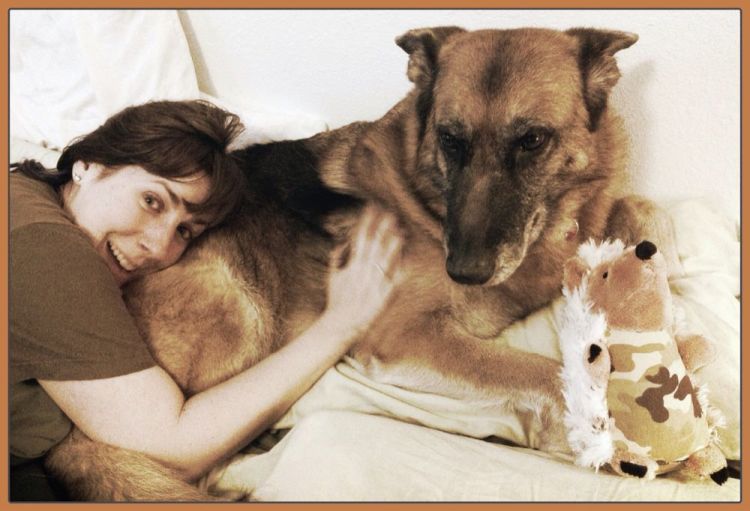
Oh no! Mia's on my pillow! She's trying to dominate me!
Oh no! Mia’s on my pillow! She’s trying to dominate me!

It’s almost absurd that I had to learn about Dominance Theory the hard way.

At least as far back as 2001, Dr. Ian Dunbar wrote in Before and After Getting Your Puppy:

If you physically force and dominate your puppy, he won’t respect you. He may heed your commands — grudgingly and fearfully — but he certainly won’t respect you. More likely, your dog will grow to resent you. …

Push-pull, leash-jerk, grab-and-shake, alpha rollover, and domination techniques are now considered ineffective, besides being adversarial and unpleasant. These out-of-date methods are now, thank goodness, by and large a thing of the past.

Dunbar, by the way, is a veterinarian and has a PhD in animal behavior. Cesar Millan, despite being the founder of something he called the Dog Psychology Center, does not have a degree in psychology. So forgive me if I refuse to accept this diagnosis on his website:

Dog aggression stems from the dog’s frustration and dominance. The dog’s frustration comes from a lack of dog exercise, and the dog’s dominance comes from a lack of calm-assertive leadership.

Wrong, wrong, wrong. (The aggression/dominance connection, anyway. I do agree that frustration often can be alleviated by increased exercise.)

Victoria Stilwell, another dog walker turned trainer turned television personality, advocates for science-based dog training. In her book Train Your Dog Positively, she writes:

Unfortunately for dogs, a dominance-related misdiagnosis of their behavior problems usually leads to the worst-case scenario: traditionally prescribed behavior-modification techniques usually include punishment, intimidation, fear — precisely the opposite of what dogs really need to overcome most behavioral issues.

This is why so many trainers and behaviorists take issue with the Dominance Theory. It prescribes owner dominance as the treatment for dog aggression because it misdiagnoses the cause as the dog’s desire to dominate the human. In truth, most dog aggression is caused by fear. When you treat a dog’s fear by trying to dominate the dog, the prognosis is more fear. More aggression.

D is for Dominance. Don’t Do it.


Powered by Linky Tools

Click here to enter your link and view this Linky Tools list…

Choke Collars, Corrections, Classical Conditioning, and Clickers

I was dimly aware of clickers being used in animal training from the time I was a child and went to the Animal Actors show at Universal Studios. I remember hearing the clicks while the trainers made the animals perform tricks, and my brother explaining that’s how they got animals to do things.

When I first learned to use a clicker with Isis, it was a revelation. She was already two years old. Our initial training experience was with an old-school trainer who had us use a pinch collar. I have since realized the lunacy of jerking a dog’s collar and calling it a “correction.” It’s not a correction if it doesn’t correct the problem, is it? Our second trainer was a woman we’ll call “Tracey,” who suggested “distracting” dogs with treats to keep them from barking and lunging at things.

The clicker was introduced to us by a positive reinforcement trainer we’ll call “Linda,” who explained the principles of classical conditioning. The following are excerpts from Bark and Lunge, where it comes together for me:

Linda handed me a two-inch-long oblong red plastic clicker with a yellow button. “Clickers are tools that focus on what the dog does right, instead of punishing them for what they do wrong. You get better communication and a better relationship with your dog.”

Linda clicked, then handed Isis a treat. “First, we need to prime the clicker.” Like Pavlov’s dogs before her, Isis caught on very quickly that the click meant something good was coming next. “Now, you can start clicking for the action you want, and give the reward when she’s in the position you want.” Linda asked Isis to sit, and clicked as soon as she started to lower her butt. When Isis had completed the move, Linda handed her a treat. “I’m reinforcing the position of sit by giving her the treat now.”

I practiced a few times, thrilled by how much Isis enjoyed the game. After each click and treat, she looked up at me eagerly.

What’s next, Mom?

“Clicker training creates an attentive dog who loves to go to work. I’ve been truly amazed at the results I’ve seen with clicker training and don’t understand why any dog trainers would still use choke collars or negative reinforcement.”

I looked guiltily at Isis’s pinch collar.

Who would put this medieval torture device on a puppy? I did, not knowing any better.

A few days later, I took Isis to a parking lot to practice classical conditioning with the clicker. Isis was amped up, as if we were in a completely unfamiliar place, even though she’d been there before. She darted to the end of her leash, moving erratically and sniffing the ground.

I clipped one end of her leash to my belt and started walking. Every time she was near my left side, I clicked and treated. If she forged ahead, I stopped and went the other direction. I knew this dance from our basic obedience classes. We were aiming for a solid heel, which Isis had yet to master. In this low-distraction parking lot, she was right there beside me, her entire focus on the treats in my hand.

Interesting. Tracey’s treat method hadn’t gotten Isis to walk beside me properly. What was different now?

The clicker.

Isis had learned that the sound of the clicker meant a treat was forthcoming. When I started to walk, she followed dutifully. I clicked as soon as she reached my side, which made her pause long enough to take a treat from my hand and process that the click marked the place where she was supposed to be. Major progress. Without the clicker, she might take the treat on her way past me to charge ahead, but I had no way to communicate that I would prefer for her to walk beside me instead.

This clicker business was genius!

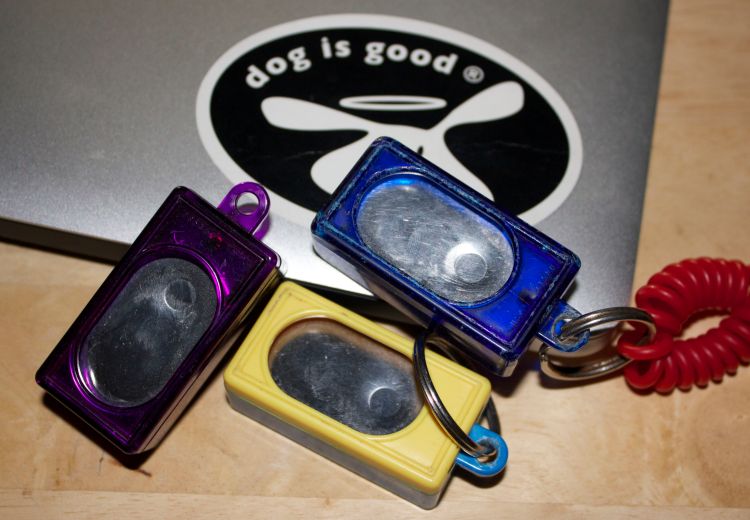
An assortment of clickers collected from our various positive reinforcement classes.
An assortment of clickers collected from various positive reinforcement classes.


Powered by Linky Tools

Click here to enter your link and view this Linky Tools list…

Five doggies looking for new Best Friends

My writer friend Pam is doing the Blogging A-Z challenge, and when I saw some of my Wordless Wednesday friends doing it as a blog hop, I wanted to join in. I’d already posted this, and realized that it fits perfectly.

B is for Best Friends!

Two weeks ago, I posted pics of three dogs at the Humane Society of Skagit Valley, where I volunteer. Two have been adopted since then! It’s really gratifying to see doggies find new Best Friends.

I’m worried about the third dog though. Maverick. He’s very sweet and cute, but he’s restless from being cooped up, and doesn’t make the best impression when you first meet him behind bars. He also suffers from Black Dog Syndrome, which makes him more likely to be overlooked in the shelter. (Black Dog Syndrome also starts with a B.)

Here he is loving life in the play yard with a rope toy.


And here are a few more doggies, still looking for for their new Best Friends.

BlogPawsWedButton

Powered by Linky Tools

Click here to enter your link and view this Linky Tools list…


B

Powered by Linky Tools

Click here to enter your link and view this Linky Tools list…
The Notorious B.U.G.

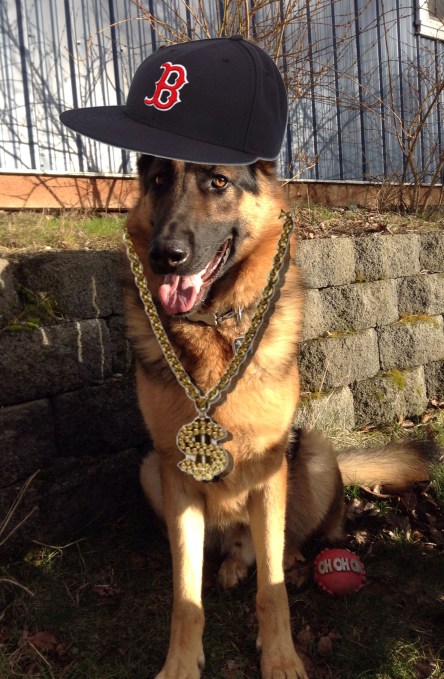
Hip-Hop Leo

Leo has a new nickname. Leo stands for Leonidas, but we call him Leo Bug most of the time. Sometimes Buggie. You see where this is going.

Rob’s been listening to Notorious B.I.G. in the car on the way to his jogs with Leo, also known as the Bug Jog. Leo, much like his mother, does not seem to be crazy about the actual jogging part. He gasses out after a lap or two, and requires a lot of encouraging to carry on.

However, Rob, the supportive and tireless coach, reports that Leo does not bark at bicycles and other dogs while jogging.

Jen deHaan was really onto something in this DOGthusiast post.

Meanwhile, I’m still working on classical conditioning with Leo. I take him to a big parking lot near a skate and bike park. Sometimes we have very peaceful walks. Sometimes I can get him close enough to the wheeled people that he sees them, yet far enough away that he doesn’t bark at them. Sometimes I totally beef it by cutting through an apartment complex to drop the poop bag in a dumpster and he winds up barking and lunging at an innocent bystander.

Unfortunately, he’s been seeming more reactive in the car, barking at everyone he sees, not just joggers, dogs, and wheeled people. It’s so bad that I ordered a Calming Cap to see if that helps. (I ordered the Thundershirt brand because Premier is now owned by a company that makes shock collars. So I guess I no longer endorse Easy Walk harnesses either. Here are some alternatives I haven’t tried myself.)

The other day, I walked the dogs together and when we got back in the car, I played Rob’s Biggie Smalls’ CD. Leo sat in the front seat, and shined the most relaxed, happy smile. He didn’t bark at anything on the way home. Obviously, he found Biggie to be calming.

I played Biggie again tonight on our way to the bike/skate park and Leo didn’t bark at a thing. Not on the way there, not on the walk, not on the way back… until a skateboard sped by on the sidewalk, startling us both. I forgive him because, come on, this was an epic walk.

At one point, we were in the middle of the parking lot, mellow as a spring evening at dusk, and Leo calmly looked away from the skaters, over to a couple of girls getting in their car after soccer practice, back to me. I rewarded him with some Ziwi Peak venison, and was thinking, Damn, I’m proud of you, kid, when a couple of bikes whizzed by on the sidewalk. I turned and ran in the other direction.

Yes. I ran.

And Leo glanced over his shoulder like, Hey, I’m supposed to bark at wheeled people, and I just kept running, and he came with me, and he did not bark and he did not lunge. And I was so proud.

Incidentally, he didn’t used to be into hip hop. When he was a pup, he bumped the volume on the car radio to turn up Twisted Sister’s We’re Not Going to Take It. Another time, he changed the station to the same song.

My mom’s Lhasa apso, Barney, was a big fan of Cyndi Lauper. One time when she was on Late Night with Conan, Barney fixed his eyes on her each time she performed, having shown no prior interest in the television.

Do your dogs have a favorite singer? 

fitDogFriday

I’m thrilled to be hopping along once again with SlimDoggy, Peggy’s Pet Place and To Dog With Love.

Powered by Linky Tools

Click here to enter your link and view this Linky Tools list…