R is for Relax Harder

I had a hard time finishing this post about getting dogs to relax, because Mia kept whining and trying to climb onto my lap. Think she’s trying to tell me something?

The idea of relaxing harder used to be kind of a theme in my life. I suffered from TMJ and headaches, and the medical professionals insinuated that these were stress-related ailments. My recovery would come when I relaxed harder.

Then I had an anxious dog, and I realized how alike we were. Could I have caused her anxiety? Was my inability to relax contagious? Or just a coincidence?

My TMJ got better, not because I learned to relax, but because I had Craniosacral Therapy that involved having a dude massage inside my mouth. In a general sense, I feel like I am more relaxed than I used to be. Certainly I’m more relaxed than I was during the seven months we lived with two dogs who couldn’t be in the same room together.

Outside of my house, though, there seems to be an epidemic of nervous and fearful dogs.

Among the possible treatments, which include Tellington Touch, ThunderShirts, ThunderCaps (just wait until T day in the A to Z Challenge), and anti-anxiety meds, is Karen Overall’s Relaxation Protocol.

The Relaxation Protocol conditions a relaxed response by rewarding a dog for sitting or lying calmly for various lengths of time in the presence of various stimuli.

Paws Abilities explains it well here.

Rubicon Days also writes about it in this post and that post.

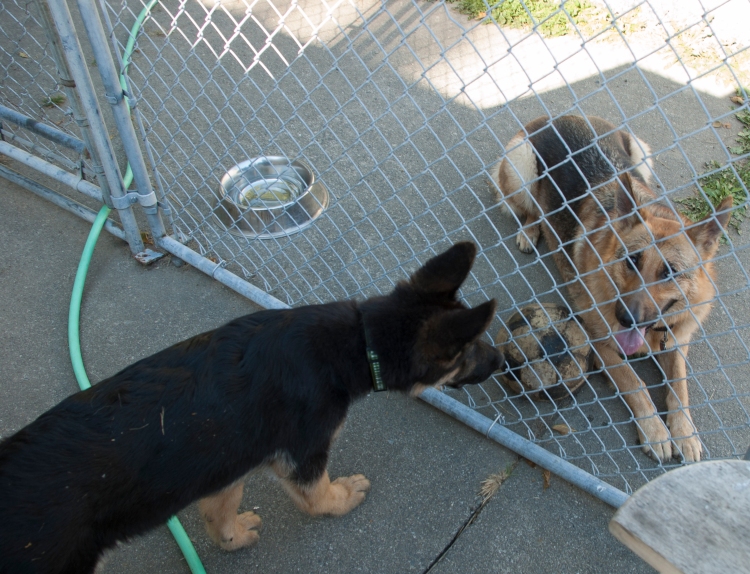
I wish there were something I could do to help shelter dogs relax harder. In the short time I’ve been volunteering, I’ve seen anxiety escalate alarmingly in a couple of dogs. One started grabbing the harness out of my hand before I put it on him, and shaking it violently. He also grabbed my hands and wrists with his mouth; definitely not behavior that is going to get a dog adopted.

Another dog who was fairly timid when I first started walking him also has started grabbing my hands. A fellow volunteer gaped at me trying to extricate my wrists from his mouth, her eyes wide like she was witnessing a murder. Like she’s never seen a spazzy dog before. He actually mouthed me kind of gently; Leo used to leave marks when he did that as a puppy. Still, the behavior can’t continue. My strategy is to turn my back and cross my arms until he calms down, but it’s not like I have all day. Maybe I can reach in with lightning speed, clip the leash to his collar and then step on it, so he can’t jump up.

As a volunteer, I take these dogs for walks and play with them outside, which I hope enriches their lives with a little stimulation and exercise. I wish I had enough time that I could also massage their ears and jaws, and do Tellington Touch body work. I wish I could hang out with each of them every day and work through the Relaxation Protocol.

While I’m throwing out wishes, I might as well wish for them all to have loving homes, or at least foster homes while they wait. Living for an extended period in a kennel is too stressful.

R is for Relax Harder

R

Powered by Linky Tools

Click here to enter your link and view this Linky Tools list…
Q is for Quitter

A rare photo of Isis and Leo together

The day we brought Leo home, and his introduction to Isis went very, very badly, my first instinct was to take Leo back. Rob talked me out of it.

In my memoir, I wrote:

Here’s where Rob and I showed our true characters. I am a quitter at heart. Rob is not.

The moment comes after thousands of words describing my efforts to train Isis. My memoir classmates constantly said things to me like, “I can’t believe how devoted you were. You never gave up.”

How to convince them that, no, really, I’m actually a quitter?

I’ve quit lots of things: violin lessons, the first university I went to, gyms, NaNoWriMo 2009. (In my defense, I didn’t quit that novel; I’m still working on it.)

There are plenty of good reasons to quit things. Ask Dave Chappelle. You may remember he walked away from a multimillion-dollar TV deal a number of years ago. In a standup perfomance last year, he talked about the parental speech he gave when his own son wanted to stop going to an after-school program: “Son, sometimes it’s okay to quit.”

Most of the things I’ve quit because they were boring or too hard. I admit it; I don’t like to work very hard. I’ve found that there are certain things I am rather good at. Can’t I just do those things, and not toil away at the other stuff? (Not one of my most admirable qualities, I’m well aware.)

I never quit Isis, that is true. And I never quit trying to get her and Leo to get along. The universe intervened on that one, and not in the way we would have liked.

I have quit dog classes. Never because they were too hard, though. These I quit because they were the wrong class or wrong trainer. (Sometimes also boring.)

I’ve given up on the fantasy that I can train Leo to be bomb-proof on a leash. Sometimes I feel like such a quitter that I think I’ve given up training my dogs altogether. So what that Leo doesn’t sit on cue, or come when I call? It’s too late for him; I’ll get it right with the next one.

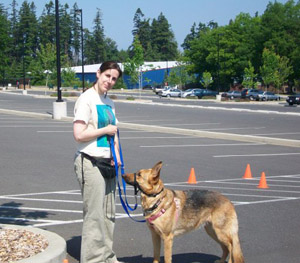
Still, I find myself strapping on his ThunderShirt, and taking him to a parking lot to practice not barking at things. And he barks and lunges and embarrasses me, and it’s hard. But then there are the moments that, despite being hard, are also kinda fun. And that’s why I keep doing it.

Q is for Quitter

Q

Powered by Linky Tools

Click here to enter your link and view this Linky Tools list…

This post probably would make more sense if I wrote it before Progress, but I have an alphabet to follow.

P is for Progress?

My favorite guys
My favorite guys

Sometimes it’s hard to tell whether you’re making progress or not.

As I’ve explained in previous posts, I’ve been taking Leo to a parking lot to work on desensitizing him to bicycles. During the cold, dark months, I discovered that the adjacent residential neighborhood has many fewer bicycles and joggers than our own neighborhood, so that’s become a regular walk route. Now that it’s warmer and lighter, we’re starting to challenge ourselves around distractions again.

The parking lot is next to a sports stadium that’s encircled with chain link. Leo pretty much ignores what’s happening on the field. Instead, he’s often triggered by teenage hooligans skateboarding through the lot. There’s a dirtbike park and a skate park next to the parking lot. That’s actually why we go there. The idea was to bring Leo close enough to the bikes and/or skaters to be interested, but not react. Unfortunately, it’s not always easy to predict when a cyclist or skater is going to cut through the lot.

Lately, the jog-away technique has been surprisingly effective.

We’ve had a couple of glorious, peaceful strolls, even when there’s a lot going on: high-school soccer in the stadium, little kid soccer on a nearby field, a little kid P.E. class on a patch of grass directly across the street from where we walk. I’ve noticed that if Leo’s leash is completely slack when he sees a stimulus like a moving bicycle (at a decent enough distance), it removes his barrier frustration and he is capable of remaining calm.

The other day, despite the soccer games on the nearby fields, and the shady characters hanging out in their parked cars (to sell drugs to the skater kids, I can only imagine. Unless they’re parents waiting to pick up their skater kids, who are also honor students), the parking lot had a very serene energy.

Skaters and cyclists were enjoying their parks, but the lot itself was quiet. Leo and I made two successful approaches where he watched the skaters and cyclists, then looked away. I praised him and we moved farther away.

He was sniffing some grass when a car pulled alongside us and a woman said through her open window, “Your dog is gorgeous.”

Yes, yes, I know, and if you look at him a second longer, he’s going to bark at you in 3, 2, 1 …

I smiled and said thank you and sort of shrugged off the barks. What does she expect from a German shepherd in a ThunderShirt?

I decided to make a third approach and get Leo to watch the dirtbike riders in particular. We walked to the fire hydrant just outside the chain-link fence. He sniffed and peed, and then noticed the group on wheels. I noticed a man leaning against a pick-up inside the stadium on the other side of the fence. Maybe a maintenance worker.

Leo watched bikes of all sizes leap through the air while maneuvering the dirt moguls. He turned back to me and I praised him, enormously proud.

Then I noticed the maintenance guy running toward us and I recognized him. Several weeks ago, he did the same thing — race toward me and Leo on the other side of the chain link. He happens to be developmentally disabled, which explains why he didn’t understand not to run directly toward us, although it does not excuse Leo barking at him. Leo would bark at anyone running toward him.

I called out, “You can’t run toward us; he’ll bark,” then turned and ran away, chirping my stupid, “C’mon, c’mon, c’mon,” cue that I give when I’m trying to redirect Leo from something scary.

Leo barked a few times; it wasn’t the scariest sound he’s ever made. (The last time he barked at a bicycle in the middle of this parking lot, it echoed throughout the stadium. I was quite grateful there were no sporting events happening at the time.) What bummed me out was feeling like we’d just had a tremendously successful exposure to the bike park, and I didn’t know what effect the running man incident had. Did it completely negate the “progress” I thought we’d made 5 seconds earlier?

Leo and I left the parking lot and made our lap around the apartment buildings where apparently no one jogs or bicycles. My mild discouragement evaporated as I realized the experience would make a good post for P day of the A to Z challenge.

Before we got back to the car, I moved Leo into a driveway to get some distance from a bicycle. I kept his leash loose and let him look. He did not bark.

So I guess he’s made some progress after all.

P is for Progress!

P

Powered by Linky Tools

Click here to enter your link and view this Linky Tools list…
 

Oh, my Outdoor Dog

jolly mia

The other day, I told you about Mysterious Mia, who likes to eat doors. Maybe the beeping of the security cameras makes her anxious. Maybe she has separation anxiety. Maybe she’s bored.

Or … maybe she’s telling us she wants to be an outdoor dog. She likely spent most of her daytime hours outside at her last home, although she wasn’t there very long. We have no idea what her life was like before that. But she lets us know all the time that she enjoys the open air.

Sometimes she doesn’t want to come in when I have to leave for work. Sometimes when Rob’s parents come by midday to let the dogs out, she decides she wants to stay there. I feel safer with her inside, but our yard is secure, and on those occasions, she leaves us no choice. She won’t come anywhere near the back door, preferring to recline in the grass outside Rob’s studio building. When we return, we usually find her lying down just outside the sliding glass door.

After last week’s destruction, I asked myself why I’m fighting her on this. She wants to be outside. Why don’t I let her stay outside?

Monday afternoon, I left the back door open while I prepped a load of laundry. I noticed Mia lying on the patio in the sunshine. She’s so happy out there; I need to stop being so overprotective.

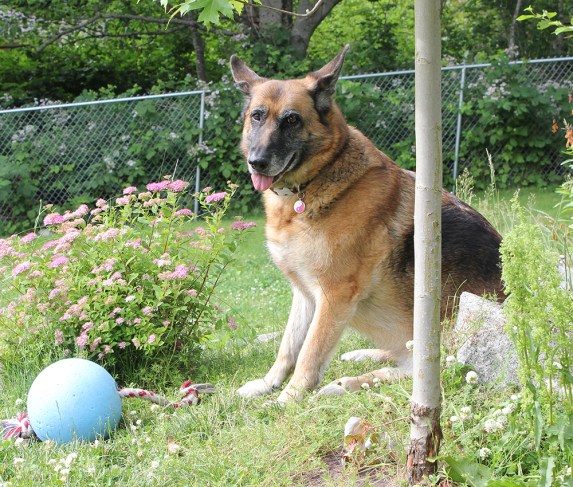
A few minutes later, Leo was standing in the spot where Mia had been. I glanced up to the hill, expecting to see her at the base of the stone wall, resting her paw (or her chin) on her Jolly Ball.

“Where’s your sister?”

I stepped outside and looked in the direction Leo faced. There was Mia, looking down into a dirt cavern beside the chain link of the dog run.

“Are you digging?”

Mia sat beside the pit and grinned at me.

It wasn’t a new hole. I couldn’t tell how much, if any, of the excavation had just happened. It wasn’t even a particularly scary place for her to dig. Not like this escape attempt. If Mia did dig under this portion of chain link, she’d still find herself within the confines of our fenced yard.

I checked her paws and found dirt under her nails. Incontrovertible evidence that my perfect dog has a mischievous side.

O is for my Outdoor Dog

O

Powered by Linky Tools

Click here to enter your link and view this Linky Tools list…

To Neuter or Not to Neuter

When we first got Isis, I didn’t know there was anything controversial about spaying and neutering dogs. I thought the only reason not to do it was if you planned to breed them.

Preventing pet overpopulation is, of course, the obvious reason to spay and neuter, but that’s not why we did it. We were a one-dog household with no intention of letting Isis stay out after curfew with wild boys. We believed the Humane Society’s list of health benefits, and to be perfectly honest, we had Isis spayed before her first heat because I didn’t want to deal with the mess. I had no idea there were health risks.

I even won a T-shirt (for me) and a little beaded necklace (for Isis) from the Humane Society for spaying her during February, because Feb 24 is World Spay Day. Isis wore that necklace her entire life. You can see it in the pictures with I is for Isis, and this one about why choke collars are bad.

Never did it cross my mind that spaying Isis contributed to her fearfulness, anxiety, and aggression later. But Dr. Sophia Yin reports:

According to Katherine Houpt, VMD, PhD, DACVB, director of the Animal Behavior Clinic at Cornell University Hospital for Animals, spaying may actually contribute to behavioral problems. In a cooperative study with the Institute of Animal Medicine at Gyeongsang National University in Korea, Houpt and her colleagues found that ovariohysterectomy (spay) in healthy German Shepherds bred as working dogs led to increased reactivity.

Then there’s Leo. By the time we got him, I had heard that it’s better to wait before neutering a dog, to allow them to mature fully. I had the best of intentions of letting Leo finish developing. But then he started humping dogs at daycare and they wouldn’t let him come back until he was neutered.

This knee-jerk castration is ridiculous, really. Behaviorist Patricia McConnell writes:

One doesn’t need to be a veterinarian or physiologist to suspect that removing hormone-producing organs has a profound effect on a body’s physiology, beyond that of eliminating the potential of reproduction. Natural selection is a conservative process, and it is rare for any hormone to play only one role in the body. Androgens produced in the testes play a role in muscle and skeletal development. Estrogens, we’re told, affect the urinary tract, the heart and blood vessels, bones, breasts, skin, hair, mucous membranes, pelvic muscles, and the brain. Thus it is reasonable to wonder what the effects truly are of neutering animals at young age, sometimes as young as a few months of age.

Injectable sterilization may be the better option for boy dogs, because testosterone is not completely eliminated, but then neither is humping, marking, or roaming.

I hope that animal shelters and rescues consider that an alternative to neutering puppies before placing them in homes. Author and trainer Steve Duno writes about the absurdity of neutering too soon (as young as eight weeks) in this article:

Research also indicates adverse behavioral issues associated with early neuter, including increased rates of noise phobias, fear aggression, and reduced intelligence. … I can tell you that an abiding professional observation of mine, after working with thousands of dogs, is that those undergoing early neutering often become either bubble-brained, slow-learning goofballs, or nervous, insecure handfuls.

I have seen no evidence elsewhere to back up the reduced intelligence claim. And yet — bubble-brained, slow-learning goofball — Sound like anyone we know? Don’t get me wrong, I am over-the-moon bonkers about Leo, but he’s not as smart as Isis or Mia. Maybe it’s just because he’s a boy, although I have to wonder, could neutering have something to do with it?

When our trainer first met him as an eight-week-old, she said, “You’ll be able to teach this dog to do anything.” I have to tell you, that hasn’t turned out to be the case.

N is for Neutering

N

Powered by Linky Tools

Click here to enter your link and view this Linky Tools list…
M is for Mystery

When you “rescue” a dog, unless it is an owner surrender with a uniquely upfront surrenderer, the dog’s previous life is a complete mystery.

We look at Mia all the time and ask her, “What were your families like before us?”

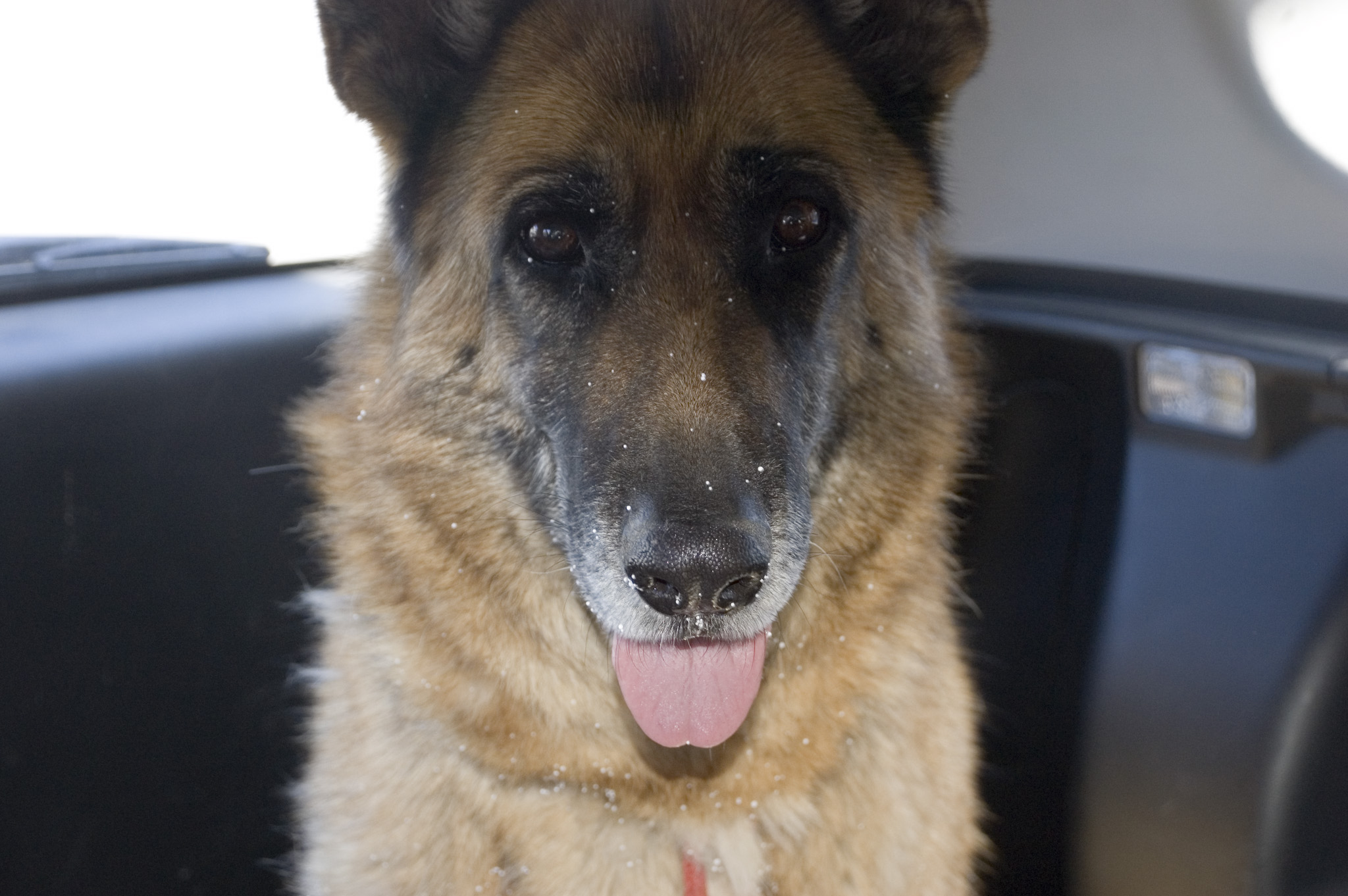
Mia hopped right in our car the day we met. Who would abandon this face? (Those aren't mites on her face, but white microbeads from a headrest Leo tore apart while we were meeting Mia.)
Mia hopped right in our car the day we met. Who would abandon this face? (Those aren’t mites, by the way, but white microbeads from a headrest Leo tore apart while we were meeting her.)

Mia came to live with us when she was about 7. The only things we know for sure are:

  • She answers to the name Mia.
  • She was microchipped but not registered.
  • She was spayed.
  • She was vaccinated.

Mia was living with a family on an Indian reservation for a few weeks, where she was probably outside, off leash, and unfenced most of the day, but slept inside at night. Her foster mother said Mia had two other families before us, and that the most recent one moved away and couldn’t take her along.

“Who would leave behind a Mia?” Rob and I ask ourselves every day.

Lately, we’ve started wondering if maybe she didn’t have a home because she ate it. We thought we’d solved the problem of door-chewing by leaving all the inside doors open, but then she started working on the door from the laundry room to the garage, and the moulding by the sliding glass door to the backyard. I fear she’ll turn on the front door next. When we got home from work on Friday, she’d torn the doorknob OFF the door to the garage, so now we can’t open it from the inside.

I took her for a long walk that evening and tried to figure it out. Why does she hate closed doors so much? Why was she close to perfect for two years before this started?

All the solutions that I can think of — leaving her outside, taking her with me, having Rob’s parents come by more often — none of those would have made a difference on a Friday when I couldn’t have taken her to work, didn’t want to leave her outside from 9 to 6*, and Rob’s parents were out of town. The best option is blocking her access to the doors. We can put an X-pen across the door to the kitchen, which keeps her away from the sliding door and the laundry room. Maybe we should blockade the front door too …

Later that night, our security cameras started beeping. After Mia’s first door destruction, I blamed the beeping from Rob’s car alarm key fob. Oh, the cruel irony. The very device that allows us to watch Mia destroy the doors could be the thing that causes her to destroy the doors.

Rob got on the phone with customer service and we think we’ve got the beeping fixed.

Again, my suspicion is that the beeping makes Mia anxious, so she tries to escape it, this time out to the garage or the backyard. Then again, maybe she’s trying to get inside the garage, where I like to hide cooked liver for her to find. I may never know.

And that’s what makes Mia a Mystery.

M

*Wondering why I don’t want to leave Mia outside from 9-6? Check back in two days for the letter O.

Powered by Linky Tools

Click here to enter your link and view this Linky Tools list…


L is for Lunging on Leashes

I’m adding this post to Blog the Change, because there’s not enough information online about the benefits of using a leash with clips on both ends. I recently had a lengthy online conversation with someone who “hates” clickers, harnesses, and head collars. He insisted that the best way to stop a dog from pulling is with a prong collar. I strongly disagree and challenge anyone struggling with a puller to try attaching a leash to the front and back of a harness, or a Halti and a harness, and see if they don’t get better results than they would with a prong collar. If you find the gear confusing, I recommend finding a force-free trainer familiar with Tellington Touch.

I played around with a couple of working titles for my memoir about Isis before I realized that obviously, I had to call it Bark and Lunge.

I don’t like to overuse descriptive phrases, so if I find that I’ve used an expression more than twice, I start looking for synonyms. There are no sufficient synonyms for barking and lunging, and since those words so perfectly described the behavior that challenged me the most, I decided to embrace it.

I don't have pictures of Isis lunging, but here she is wearing a Halti and a "balance" lead that helped me teach her not to lunge.
I don’t have pictures of Isis lunging, but here she is in 2009 wearing a Halti, harness, and a “balance” lead that helped me teach her not to lunge.

I’ve written before about clicker training, but another key element to alleviating Isis’s anxiety and leash-reactivity was using a leash that had two points of contact. We used a Halti head collar on Isis, but if your dog doesn’t go for that, you can attach a two-ended leash to the front and back of their harness. This can be done easily with a Freedom Harness or Victoria Stilwell’s Positively Harness.

Ironically, Isis was in an “off-leash obedience” class when she first started showing leash reactivity. The trouble was, a good portion of the class was still on-leash.

Funny thing about barking and lunging: I wasn’t even aware it was a thing before I had a reactive dog. As often as Isis did it, I don’t think I even had the words until I sought help from a trainer and needed to decribe her problem behavior. The way I initially perceived the lunge was straining against her leash.

Everyone knows what barking is, and all dogs do it. It’s not even necessarily problem behavior.

Lunging though. That wouldn’t exist if we didn’t keep dogs on leashes.

What a lunge would look like without a leash.
What a mighty lunge looks like without a leash.

I’m not arguing against leash laws. I have fairly strong voice control over Mia, and I’d still prefer to walk her on a leash in populous areas, but that’s because she’s not reactive.

For a leash-reactive dog like Leo, what would happen if he tried to lunge, but he wasn’t on a leash? He’d just find himself running, and then, because there was no barrier holding him back, he wouldn’t experience any barrier frustration. I don’t even think he’d bark… and the vicious bark and lunge cycle would be broken. Maybe.

Speaking of vicious cycles, I suspect Leo’s leash-reactivity stems back to his formative months when we tried to get Isis to tolerate him. We paraded Leo past her on a leash, while she barked and lunged at him. Is it any wonder he lashes out at stuff when he’s on leash?

L is for Lunging on Leashes

L

Powered by Linky Tools

Click here to enter your link and view this Linky Tools list…

Blog the Change
Powered by Linky Tools

Click here to enter your link and view this Linky Tools list…

K is for Kisses

Kissing Dogs!

Lucy, you and I are going to have to agree to disagree on this one.

I love kissing dogs. On their heads, on their beaks… on the lips! I don’t care who knows it.

Isis smothered us with kisses; Leo and Mia, not so much. Leo is so sparing with his kisses, he’ll lick the side of Rob’s face once a day, tops. This morning he licked each of Rob’s ankles.

Dogs’ lips are called “flews,” and they’re frequently black. I find Leo’s irresistible. I like to plant great big kisses on the side of his mouth, right smack on the flew. He … tolerates it. Or at least he doesn’t bite me in the face. (Not recommended for children under 25.)


K


Powered by Linky Tools

Click here to enter your link and view this Linky Tools list…

J is for the Joy of Jolly Balls

File under things I wish someone had told me about sooner.

The Joy of Jolly Balls

Isis went through a lot of soccer balls. She’d have one favorite at time and fixate on it. You could throw any other ball and she’d ignore it, because she wanted that one ball, flattened and muddy, peeling, and disgusting, until I threw it away and she’d fixate on another ball.

After we got Mia, we discovered the Jolly Ball. Generally speaking, I think $25 is a lot to spend on a ball, but if it lasts forever? It’s a hell of a deal. Mia immediately fixated on the blue Jolly Ball. Unlike Isis, she doesn’t pass us the ball to throw to her; she guards it with a paw rested on top, barking at us.

Later, we bought a red Jolly Ball, which became Leo’s. While not as obsessive as Isis was, he’ll roll the ball down the hill to us and chase after it when we throw it. He’s still 50-50 on the bringing it back part.

Then we added a light blue Jolly Ball with a rope through it. It smells like blueberries. What’s funny is that the original blue Jolly Ball is Mia’s, the red one is Leo’s, and they share the blueberry ball.

Now I can’t take a picture in the backyard without a Jolly Ball in it, usually with Mia barking at me about it.

J is for the Joy of Jolly Balls

J

Powered by Linky Tools

Click here to enter your link and view this Linky Tools list…

WOOF! I is for Isis

Brought to you by the letter I and the WOOF Support Blog Hop.

I is for Isis, the most beautiful name of the most beautiful dog in the world.

Finding a picture of Isis that hasn't already been used is way harder than telling you what I love about her.
Isis the Smiley Bird in Springtime

What Do I Love About My Reactive Dog?

Funny you should ask.

After Isis bit someone, her victim referred me to a positive reinforcement trainer. Before we started work, I had to fill out a lengthy questionnaire:

Q. List your priorities. What would make life with your dog easier? What can you tolerate? What can’t you tolerate?

A. Life would be easier if I didn’t have to worry so much when taking her out in public. I would like to walk her without her lunging and barking at bicycles. I certainly want to prevent her from biting people. I would like to take her to the dog park. I would like to have visitors over without her barking at them when they arrive.

After pages of describing Isis’s flaws, I smiled at the final question.

Q. Last but not least, what is wonderful about your dog?

I loved that question! I imagined other dog owners going through this application process, fed up, ready to rehome their dog, thinking they had the worst dog in the world. Here our trainer was reminding those people to stop and remember why they had a dog in the first place. Not that I needed that reminder.

A. Pretty much everything. I asked Rob, and he said, “Her smile.” It’s true, she is a very happy, friendly dog. Very smart, affectionate, and sweet. I love playing with her and walking her (when she’s not barking and lunging at things, or pulling on the leash). I love when she rests her head in my lap. I love watching her chew on her toys and race around the backyard and chase soccer balls. Before she started getting into trouble at the dog park, I loved watching her play with other dogs.

Isis has been gone three years now, but what I loved about her … what I still love about her? So easy.

Everything.

Do you have a reactive or fearful dog? Please join us and share your story. The Blog Hop is open through Sunday, April 13, hosted by Oz the Terrier, Roxy The Traveling Dog and Wag ‘n Woof Pets.

Powered by Linky Tools

Click here to enter your link and view this Linky Tools list…
Oz the Terrier

I is for Isis

I